CSE (Artificial Intelligence)
The Department of
Computer Science and Engineering (Artificial Intelligence) was established with
the objective of blending strong foundations in core computer science with the
rapidly evolving fields of Artificial Intelligence (AI) and Machine Learning (ML).
The department is committed to nurturing technically proficient, innovative,
and ethically responsible professionals who can design and develop intelligent
systems to solve complex real-world problems. With the increasing adoption of
AI technologies across industries, the department aims to prepare students to
meet global technological demands and contribute meaningfully to societal
advancement.
The academic framework
of the department is carefully designed to provide a balanced combination of
theoretical knowledge and practical skills. Students are introduced to
fundamental subjects such as Data Structures, Algorithms, Operating Systems,
Database Management Systems, Computer Networks, and Software Engineering, which
form the backbone of computer science education. Building upon this foundation,
the curriculum advances into specialized domains including Machine Learning,
Deep Learning, Natural Language Processing, Computer Vision, and Reinforcement
Learning. Strong emphasis is placed on mathematical and statistical concepts
such as Linear Algebra, Probability, and Optimization, which are essential for
understanding and developing AI models.
The department is
equipped with modern laboratories featuring high-performance computing systems
and the latest software tools to support AI research and development. Smart
classrooms and high-speed internet facilities create an effective learning
environment that encourages innovation and collaboration. Students gain
hands-on experience through laboratory sessions, mini projects, internships,
and major projects that focus on real-time AI applications.
Courses and Intake Capacity
Programme Offered
- Bachelor of Technology (B.Tech) in CSE (Artificial Intelligence)
Intake Capacity
Programme Highlights
- Curriculum structured as per the guidelines of APJ Abdul Kalam Technological University (KTU)
- Covers core subjects: Thermodynamics, Fluid Mechanics, Manufacturing Engineering, Machine Design, Heat Transfer, CAD/CAM and Automation
- Emphasis on laboratory-based learning, project work and internships, industry exposure and training
- Integrates both theoretical knowledge and hands-on practical experience, ensuring students are industry-ready
Career Opportunities
- Manufacturing and production industries
- Automotive and aerospace sectors
- Energy and power industries
- Design and simulation fields
- Higher studies and research
Optional: Hostel Fees
₹6,500 / month (Includes accommodation & mess)
One-time deposit: ₹10,000 (Refundable)
● To provide advanced AI training, emphasizing modern technologies and research to solve real-world problems.
● To create a strong entrepreneurial ecosystem that unites industry and academia to drive innovation.
● Inspire students to facilitate the development of professional behaviour, ethical values for the betterment of the society.
- PEO1: Think analytical skills to design innovative solutions for real-life challenges, preparing professionals for industry or entrepreneurship.
- PEO2: Embrace lifelong learning to meet ever changing developments in Artificial Intelligence in a sustainable manner.
- PEO3: Become socially responsible engineers with good leadership qualities and effective interpersonal skills with ethical responsibilities.
- PSO1: Develop and apply practical knowledge to create innovative solutions and contribute new ideas.
- PSO2: Analyze and design computational models and systems in domains related to Artificial Intelligence and robotics.
- PSO3: Utilize advanced Artificial Intelligence concepts, methodologies, and strategies to develop sustainable, high-quality products leveraging AI technologies.
PO -2019 scheme
- PO1. Engineering Knowledge: Apply the knowledge of mathematics, science, engineering Fundamentals, and an engineering specialization to the solution of complex engineering problems.
- PO2. Problem Analysis: Identify, formulate, review research literature, and analyze complex engineering problems reaching substantiated conclusions using first principles of mathematics, natural sciences, and engineering sciences.
- PO3. Design/ Development of Solutions: Design solutions for complex engineering problems and design system components or processes that meet the specified needs with appropriate consideration for the public health and safety, and the cultural, societal, and environmental considerations.
- PO4. Conduct Investigations of Complex Problems: Use research-based knowledge and research methods including design of experiments, analysis and interpretation of data, and synthesis of the information to provide valid conclusions.
- PO5. Modern Tool Usage: Create, select, and apply appropriate techniques, resources, and modern engineering and IT tools including prediction and modeling to complex engineering activities with an understanding of the limitations.
- PO6. The Engineer and Society: Apply reasoning informed by the contextual knowledge to assess societal, health, safety, legal and cultural issues and the consequent responsibilities relevant to the professional engineering practice.
- PO7. Environment and Sustainability: Understand the impact of the professional engineering solutions in societal and environmental contexts, and demonstrate the knowledge of, and need for sustainable development.
- PO8. Ethics: Apply ethical principles and commit to professional ethics and responsibilities and norms of the engineering practice.
- PO9. Individual and Team Work: Function effectively as an individual, and as a member or leader in diverse teams, and in multidisciplinary settings.
- PO10. Communication: Communicate effectively on complex engineering activities with the engineering community and with society at large, such as, being able to comprehend and write effective reports and design documentation, make effective presentations, and give and receive clear instructions.
- PO11. Project Management and Finance: Demonstrate knowledge and understanding of the engineering and management principles and apply these to one’s own work, as a member and leader in a team, to manage projects and in multidisciplinary environments.
- PO12. Life-long learning: Recognize the need for, and have the preparation and ability to engage in independent and life-long learning in the broadest context of technological change
PO -2024 scheme
- PO1. Engineering Knowledge: Apply the knowledge of mathematics, science, engineering Fundamentals, and an engineering specialization to the solution of complex engineering problems.
- PO2. Problem Analysis: Identify, formulate, review research literature, and analyze complex engineering problems reaching substantiated conclusions using first principles of mathematics, natural sciences, and engineering sciences.
- PO3. Design/ Development of Solutions: Design solutions for complex engineering problems and design system components or processes that meet the specified needs with appropriate consideration for the public health and safety, and the cultural, societal, and environmental considerations.
- PO4. Conduct Investigations of Complex Problems: Use research-based knowledge and research methods including design of experiments, analysis and interpretation of data, and synthesis of the information to provide valid conclusions.
- PO5. Modern Tool Usage: Create, select, and apply appropriate techniques, resources, and modern engineering and IT tools including prediction and modeling to complex engineering activities with an understanding of the limitations.
- PO6. The Engineer and Society: Apply reasoning informed by the contextual knowledge to assess societal, health, safety, legal and cultural issues and the consequent responsibilities relevant to the professional engineering practice.
- PO7. Ethics: Apply ethical principles and commit to professional ethics and responsibilities and norms of the engineering practice.
- PO8. Individual and Team Work: Function effectively as an individual, and as a member or leader in diverse teams, and in multidisciplinary settings.
- PO9. Communication: Communicate effectively on complex engineering activities with the engineering community and with society at large, such as, being able to comprehend and write effective reports and design documentation, make effective presentations, and give and receive clear instructions.
- PO10. Project Management and Finance: Demonstrate knowledge and understanding of the engineering and management principles and apply these to one’s own work, as a member and leader in a team, to manage projects and in multidisciplinary environments.
- PO11. Life-long learning: Recognize the need for, and have the preparation and ability to engage in independent and life-long learning in the broadest context of technological change.
Selected as District Winner – YIP 8.0
In a proud achievement for the institution, Dany Konnakottu Simon of S6 CSE-AI and Sharon Anna Geji of S6 CSE have been selected as District Winners in the prestigious Young Innovators Programme (YIP) 8.0, organized by K-DISC, Government of Kerala. The recognition was awarded for their outstanding innovation, creativity, and problem-solving skills demonstrated during the competition. The Young Innovators Programme is a significant initiative aimed at nurturing innovative ideas and encouraging young talents across the state. Competing among numerous participants, the team’s project stood out for its originality and practical relevance. Following their district-level success, the team has been shortlisted for the State Level Evaluation, marking another important milestone in their journey. This achievement brings great pride to the institution and highlights the growing culture of innovation among student.
Level 2 – Medal of Appreciation
Viknesh A, a sixth-semester student of Computer Science and Engineering (Artificial Intelligence), has been honored with the Level 2 – Medal of Appreciation at the prestigious I.A.C – iNNOVIZE International Online Talent Search Event. The recognition was awarded for his remarkable artistic excellence and outstanding creative proficiency. The international event brought together talented artists from across India as well as Non-Resident Indians from various countries, making the achievement highly significant. Viknesh’s artwork stood out for its quality, creativity, and unique expression, earning him appreciation at a global platform. This achievement reflects his dedication, passion, and talent in the field of art, bringing pride to the institution. The college community has extended heartfelt congratulations to Viknesh A and wished him continued success in all his future artistic endeavors.
COLLEGE UNION CHAIRPERSON-MBCCET 2026
Mar Baselios Christian College of Engineering and Technology (MBCCET), Kuttikkanam, Peermade, proudly announces the selection of the Chairperson for the College Union 2026. The position has been awarded to Kewin Mathew Koshy, a third-year student from the CSE–AI (Computer Science and Engineering – Artificial Intelligence) Department.The selection marks a significant achievement for the CSE–AI department, highlighting the leadership potential, dedication, and active involvement of its students in institutional activities. Kewin Mathew Koshy’s appointment reflects his commitment to student welfare, academic excellence, and collaborative leadership.
2nd runners-up position in the C-Zone Handball Tournament
Mar Baselios Christian College of Engineering and Technology (MBCCET) proudly congratulates the women’s handball team for securing the 2nd runners-up position in the C-Zone Handball Tournament. The team demonstrated exceptional teamwork, determination, and sportsmanship, bringing great pride to the institution. The winners from the CSE–AI Department are Ann Mary Binu (S2 A Batch), Ashly Mariyam Shibu (S2 A Batch), Abiah Shaiju (S4), and Anna Sunil (S4). Their achievement reflects dedication, discipline, and all-round excellence in both academics and sports.
AI Video Generation Competition
The μYear – AI Video Generation Competition was successfully conducted as part of MBC:80 under μLearn MBCCET, showcasing exceptional creativity and innovative applications of artificial intelligence. The competition provided a dynamic platform for participants to explore AI-driven storytelling by presenting unique and imaginative perspectives on New Year celebrations across diverse and creative themes.The event witnessed outstanding participation, with students demonstrating originality, technical excellence, and innovative use of AI tools in video generation. Each submission reflected a blend of creativity and technology, highlighting the potential of artificial intelligence in digital storytelling and visual media.The competition proudly announced Sneha Biju (S6 CSE AI) as the winner of the AI Video Generation Competition. Her work stood out for its creativity, conceptual depth, and effective integration of AI technologies. The winning poster features a visually striking design that blends fantasy and futuristic elements, symbolizing innovation, creativity, and the transformative power of artificial intelligence.
Poster Designing Competition
The Institution of Engineers (India) – MBCCET Student Chapter conducted a Poster Designing Competition as part of the Engineers’ Day 2025 celebrations. The event was organized in online mode with the theme “From Ideas To Impact: The Engineer's Role in Building Tomorrow”, encouraging students to creatively express the role of engineers in shaping the future. The competition received enthusiastic participation from students, showcasing innovative ideas and artistic talent. Ganga P Gopan (S6, CSE–AI) won the competition and was awarded a cash prize of ₹1000 for the outstanding poster design.
Women’s Chess Team Secures 2nd Runners-Up Position
MBCCET proudly congratulates its women’s chess team Arshina Beevi and Sneha Biju of S6 CSE–AI for securing the 2nd runners-up position in the C Zone Chess Tournament. Their commendable performance reflects dedication, strategic excellence, and sportsmanship. The institution extends heartfelt congratulations and wishes them continued success in future competitions.
Team FastByte 2.0 Selected as Global Nominees – NASA Space Apps Challenge 2025
Team FastByte 2.0 has brought pride to MBCCET by being selected as Global Nominees in the prestigious NASA Space Apps Challenge 2025. The team comprises Alan Thomas, Bibin Raju, Mathews Vinoy, and Melvin Sabu from S7 CSE, along with Elena Elizhiba Sony and Sivani S from S1 CSE AI-B. Their achievement reflects innovation, teamwork, and technical excellence.
TINKER HUB Campus Lead
Shaun David Prince, a student of S5 CSE-AI (2023–2027 Batch), has been selected as the TINKER HUB Campus Lead. His appointment marks a significant step toward fostering innovation and promoting technology-driven initiatives on campus. As Campus Lead, it will coordinate activities that encourage learning, collaboration, and creative problem-solving among students.
Women’s Day Celebration and Poster Competition
On the occasion of International Women’s Day, MBCCET organized a special celebration to honor and appreciate the achievements and contributions of women in various fields. As part of the event, a Poster Competition was held to encourage creativity and awareness about women’s empowerment. Karthik S. Kurup, a student of CSE-AI, participated enthusiastically in the competition and secured the Second Prize, showcasing exceptional artistic skills and a strong message through his poster.
TINK-HER-HACK HACKATHON
S4 CSE(AI) students(Alka Martin, Sneha Biju) have secured Third Position in the Tink-Her-Hack Hackathon held at MBCCET. The purpose of Priyam Web is to create a digital platform that simplifies life for elderly individuals by addressing the challenges they face in accessing and navigating technology.
INTERNATIONAL CONFERENCE, SENERGY-2025
AI Department participated in the Senergy Conference at MBC and secured the First Prize in the Decoration category! This achievement reflects our team's creativity, innovation, and dedication. A big thank you to everyone who contributed to this success.
SECOND PRIZE AT NAKSHATRA 2025
Aaron Sunu Mathew has secured Second Prize in Inkless Mysteries at Nakshatra 2025, a prestigious technical and cultural fest held at Saintgits College of Engineering, Kottayam.
PRIYAM-TINK-HER-HACK HACKTHON
S4 cse(AI) students(Alka Martin, sneha biju) have secured Third Position in the Tink-Her-Hack Hackathon held at MBCCET. The purpose of Priyam Web is to create a digital platform that simplifies life for elderly individuals by addressing the challenges they face in accessing and navigating technology.
NASA Space App Challenge Winners 2024
NASA Space App Challenge Winners Honored at CSE(AI), Mar Baselios Christian College of Engineering and Technology, Peermade Team Hoshiko of members Shaun David Prince-CSE(AI), Mohil C-CSE(AI), Manu V-CSE(AI), and Karthik S Kurup-CSE(AI) have been recognized for their outstanding contributions to the NASA Space App Challenge & their project was selected as one of the Top 10 Leading project and selected as Global Nominees. The local event was held at VISAT College in Elanji, Ernakulam.
Our Teaching Learning Process emphasizes experiential learning through real-world Kaggle challenges, automated continuous evaluation pipelines, collaborative peer programming, and mandatory industrial real-world project phases under faculty guidance.

1. INTRODUCTION
This report explains the academic process followed by the institution to ensure effective teaching–learning practices and to achieve the target pass percentage. The process includes course planning, academic activities, student mentoring, continuous assessment, and improvement strategies monitored through academic audits.
2. COURSE PLANNING AND CLASS COMMENCEMENT
At the beginning of each semester, course planning is carried out by the faculty members. This includes preparing lesson plans, scheduling lectures, and organizing teaching resources. Once planning is completed, classes commence according to the academic calendar.
3. ACADEMIC ACTIVITIES
The institution organizes different types of activities to enhance student learning and development:
• Curricular Activities:
Regular classroom teaching, laboratory sessions, and completion of syllabus as prescribed by the university.
• Co-curricular Activities:
Seminars, workshops, technical presentations, and academic competitions related to the course.
• Extra-curricular Activities:
Sports, cultural events, and club activities that contribute to overall personality development.
4. CLASS COMMITTEE MEETINGS
Periodic class committee meetings are conducted with faculty members and student representatives. These meetings help in reviewing course progress, collecting feedback from students, and addressing any academic difficulties.
5. STUDENT SUPPORT AND MENTORING
Faculty mentors provide academic and personal guidance to students. Mentoring helps identify students’ strengths and weaknesses and provides necessary support to improve academic performance.
6. INTERNAL ASSESSMENT AND RESULT ANALYSIS
Students are evaluated through internal assessment tests, assignments, and other academic activities. The results are analyzed to understand the overall performance of students and to identify both high-performing and weak students.
7. IDENTIFICATION OF BRIGHT AND WEAK STUDENTS
Based on the assessment results:
• Bright Students:
Students are encouraged to participate in advanced learning activities such as Massive Open Online Courses (MOOCs), research work, and paper publications.
• Weak Students:
Students are provided with remedial support to help them improve their academic performance.
8. REMEDIAL MEASURES FOR IMPROVEMENT
Remedial measures include special coaching classes, additional assignments, doubt-clearing sessions, and personal guidance from faculty members to help weak students perform better.
9. ACHIEVEMENT OF TARGET PASS PERCENTAGE
Through continuous monitoring, mentoring, and academic support, the institution aims to achieve the target pass percentage for each course and ensure overall academic success.
10. INTERNAL AND EXTERNAL ACADEMIC AUDITS
The entire academic process is regularly reviewed through internal and external academic audits. These audits ensure that the teaching–learning process meets quality standards and helps in implementing improvements wherever necessary.

11. IDENTIFICATION OF STUDENT CATEGORIES

Students are generally categorized based on their academic performance and learning pace into two groups:

• Slow Learners
• Advanced Learners

This classification helps faculty members design appropriate support mechanisms to improve learning outcomes.

12. SUPPORT FOR SLOW LEARNERS

Slow learners are students who require additional guidance to understand course concepts.
To help them improve their academic performance, the following measures are implemented:

• Remedial Classes:
Extra classes are conducted to explain difficult topics in a simpler manner.

• Group Study Sessions:
Students are encouraged to learn collaboratively with peers to improve understanding.

• Remedial Tests:
Special tests are conducted to evaluate improvement after additional coaching.

• Tutorial Sessions:
Faculty members provide one-on-one or small group guidance to clarify doubts and strengthen basic concepts.

These activities help slow learners gain confidence and improve their academic results.

13. OPPORTUNITIES FOR ADVANCED LEARNERS

Advanced learners are students who demonstrate strong academic abilities and interest in deeper learning.
The institution encourages them to enhance their knowledge and skills through the following activities:

• NPTEL Courses:
Students are motivated to enroll in online courses to gain additional subject knowledge.

• Webinars and Workshops:
Participation in academic webinars and workshops broadens their understanding of emerging technologies.

• Technical Competitions:
Students take part in technical events to apply their knowledge practically such as hackathons.

• National and International Conferences:
Advanced learners are encouraged to present research papers and participate in conferences.

These initiatives help advanced learners develop research skills, technical expertise, and competitive readiness.

14. BENEFITS OF CATERING TO STUDENT DIVERSITY

Providing tailored support for different categories of learners results in several benefits:

• Improvement in overall academic performance
• Increased student confidence and motivation
• Enhanced skill development
• Better preparation for higher education and career opportunities

15. CONCLUSION

Catering to student diversity is an essential component of an effective teaching–learning process.
By providing remedial support to slow learners and advanced opportunities for high-performing students,
the institution ensures inclusive education and promotes academic excellence for all students.
The Department Quality Assurance Cell monitors academic delivery standards, outcome attainments, and standardizes continuous internal evaluation procedures to ensure strict compliance with institutional criteria.
Department Advisory Board (DAB) is constituted with the
following members for the development and progress of the Electrical and
Electronics Engineering Department for the academic year 2024–2025.
Sl. No. | Name | DAB Role | Designation & Organisation |
| 1. | Dr. V. I. George | Member | Principal MBC College of Engineering |
| 2. | Prof. Elias Janson | Member | Vice-Principal MBC College of Engineering |
| 3. | Prof. Annie Chacko | Convener | HOD-CSE-AI MBC College of Engineering |
| 4. | Mr. Alexy Meppurathu Binu | Industry Representative | Founder/CEO Aetherspcae Ecosystem Bengaluru |
| 5. | Dr. Jubilant Kizhakkethottam | Academic Representative | Professor Saintgits College of Engineering. Kottayam |
| 6. | Dr. P.V. Rajaraman | Academic Representative | Former HOD of AI&CTO Adi Shankara Institute of Engineering & Technology, Kalady |
| 7. | Dr. Sangeetha Jose | Academic Representative | Asscoate Professor Rajiv Gandhi Institute of Technology, Kottayam |
| 8. | Prof. Sandra S Nair | Member | Assistant Professor MBC College of Engineering |
| 9. | Prof. Sobin Mathew | Member | Assistant Professor MBC College of Engineering |
| 10. | Merlin Joshi | Member | Assistant Professor MBC College of Engineering |
| 11. | Prof. Jeena Mary Kurian | Member | Assistant Professor MBC College of Engineering |
| 12. | Mr. John K Samuel | Parent Representative | Teacher St. Stephens Higher Secondary School, Pathanapuram |
| 13. | Mr. Kevin Mathew Koshy | Student Representtative | S4-CSE-AI MBC College of Engineering |
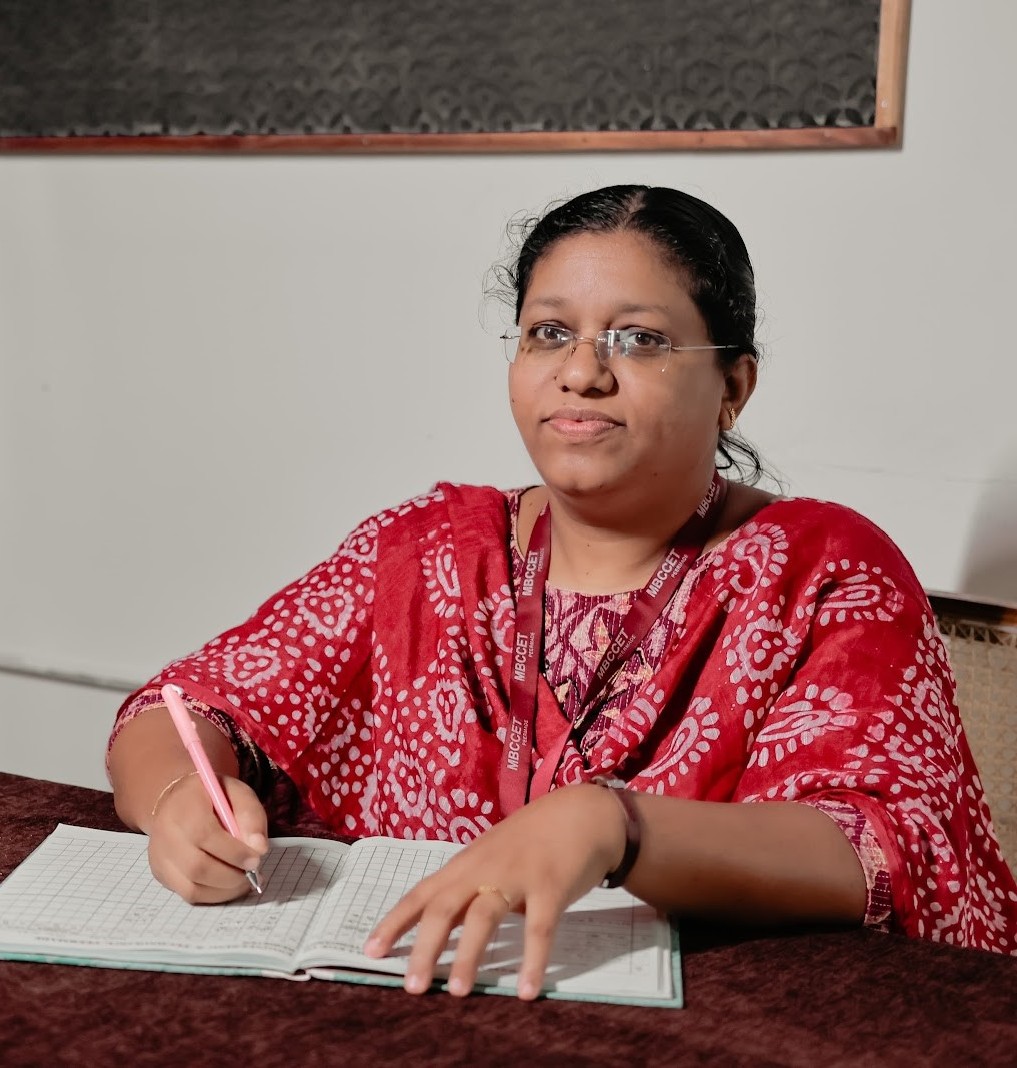
Prof. Annie Chacko


Facilities - Overall description
The Department of Computer Science & Engineering (Artificial Intelligence) provides students with state-of-the-art and modern laboratory facilities to support both academic and research-oriented learning. In addition to the laboratories mandated by the university syllabus, the department offers advanced facilities designed to nurture innovation, experimentation, and research in emerging areas of Artificial Intelligence
Lab Name, details and photos
- IT Workshop
- Python Programming Lab
- C Programming Lab
- Data Structures Lab
- Operating System Lab
- Database Management System Lab
- Artificial Intelligence & Machine Learning Lab
- Robotics Lab
- System Software Lab
Department Library
The Department
Library of the CSE-AI department has recently introduced a collection of
academic journals, providing students with access to up-to-date research,
technical papers, and advancements in the field of Computer Science and
Artificial Intelligence. These journals are valuable for enhancing knowledge,
supporting assignments, and guiding research activities.
In addition to
journals, the library also maintains a collection of mini project reports
completed by previous students. These reports are carefully preserved and made
available for reference, helping current students understand project
structure, methodologies, and implementation ideas. This serves as a useful
resource for inspiration and guidance while working on their own projects.
The library is
managed under the supervision of Prof. Merlin Joshi, who ensures proper
organization, accessibility, and maintenance of all resources. She also guides
students on how to effectively utilize the available materials for academic
growth.
Facilities and Resources
- Collection of core textbooks covering all major CSE (Artificial Intelligence) subjects
- Availability of reference books for advanced study and competitive exams
- Access to previous year question papers and study materials
- Manuals and lab records for practical courses
- Selected journals and magazines related to engineering and technology
Key Features
- Supports both curriculum-based learning and self-study
- Provides easy access to subject-specific materials within the department
- Acts as a quick reference center for projects and seminars
- Maintained and updated periodically as per syllabus requirements
Utilization
- Students: Exam preparation, assignments and seminars, mini and major project work
- Faculty: Teaching support, research and content development
- Opportunities for internships, seminars, and interdisciplinary learning
- Fosters innovation, critical thinking, and professional development
- Balanced blend of fundamental sciences and advanced courses
- Periodically updated per industry and technology trends
Batch Wise Calendars
GEN201-HACKATHON
A 24-hour continuous hackathon titled “Gen 201 – Creating the Next Generation” was successfully conducted on 10th and 11th October 2025 at Mar Baselios Christian College of Engineering and Technology (MBCCET), Peermade. The event was hosted by the Department of Computer Science (Artificial Intelligence) with the objective of nurturing innovation, creativity, and technical skills among young students. This hackathon was organized as an All-Kerala level event for Plus One and Plus Two students from government and government-aided higher secondary schools across all districts of Kerala. The event aimed to introduce students to Artificial Intelligence and its real-world applications, while supporting their future academic and career aspirations.
Objectives of the Hackathon
The main objectives of Gen 201 were:
- To develop problem-solving, critical thinking, and innovation skills among students
- To introduce students to AI concepts and emerging technologies
- To provide hands-on experience in teamwork, ideation, and project development
- To guide students towards future studies and careers in technology
- Event Name: Gen 201 – Creating the Next Generation
- Type: 24-Hour Hackathon
- Dates: 10th & 11th October 2025
- Venue: Mar Baselios Christian College of Engineering and Technology, Peermade
- Host Department: Computer Science (Artificial Intelligence)
- Participants : 11th and 12th students from all districts of Kerala
2016
2017
2018
2019
2020
2022
2023
Explore our highly anticipated departmental newsletters detailing breakthrough student achievements, expert guest talks, published papers, and upcoming technical symposia.
- INTELLIX 25 AI Newsletter - Published April 2026
- AI Horizon Bi-annual Technical Digest - Published Dec 2025
|

Memorandum of
Understanding (MoU) Signed Between Mar Baselios Christian College of
Engineering & Technology and TRETSEC Technologies LLP
The Department of Computer Science and
Engineering (Artificial Intelligence), Mar Baselios Christian College of
Engineering & Technology, Kuttikkanam, signed a Memorandum of Understanding
(MoU) with TRETSEC Technologies LLP, Kochi on 8th August 2025.This MoU aims to
establish a collaborative framework for student training, technical workshops,
internships, project guidance, and consultancy in various emerging technology
areas, including:
● Artificial Intelligence & Machine Learning
● Cyber Security & Ethical Hacking
● UI/UX Design
● Full Stack Web Development
● Java & Python Programming
● Data Science & Analytics
● Life Skills & Soft Skills Development
● Key Highlights of the Collaboration:
● Structured training programs, workshops, and
bootcamps.
● Internship, final year project, and project
support with live project exposure.
● Faculty development programs to enhance
technical and teaching skills.
● Joint organization of seminars, hackathons,
ideathons, and technical events.
● Customized training aligned with industry
needs and trends.
● Placement support, resume building, and
interview preparation.
Special certifications in UI/UX, Cyber
Security (ISO 27001), Data Science, and Artificial Intelligence.
The MoU will remain in effect for two years from the date of signing and may be
extended upon mutual agreement. This collaboration aims to enhance student
employability, foster industry-academia linkage, and provide hands-on exposure
to real-world technologies.
| Sl. No | Batch | Status |
|---|---|---|
| 1 | 2021-2025 | To Be Declared |
| 2 | 2020-2024 | To Be Declared |
| 3 | 2019-2023 | Available |
| 4 | 2018-2022 | Available |